Common Towing Mistakes That Damage Your Vehicle (And How to Avoid Them)
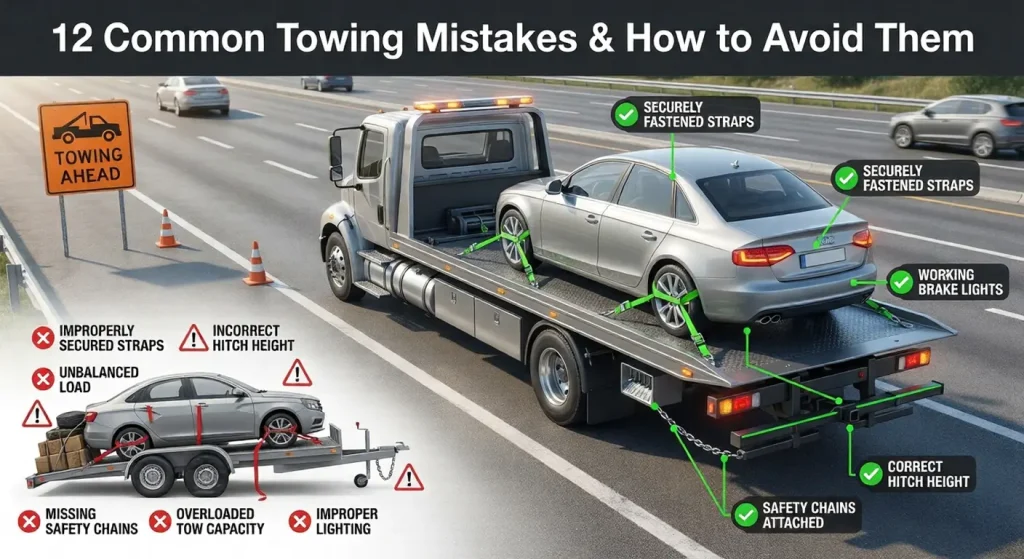
One wrong move during a tow can turn a minor roadside headache into a five-figure repair bill. Common towing mistakes include using the wrong tow truck or towing method, incorrect hooking or securing, exceeding weight limits, poor load distribution, mismatched hitches or tow balls, worn tyres and brakes, and driving too fast.
And that is just the beginning. There are many more mistakes that can ruin a tow, but how do you avoid them?
Each towing error not only risks costly repairs but can leave you stranded on a scorching Perth highway, damage a perfectly good drivetrain, or even cause a serious accident.
This guide will discover exactly why each mistake happens, how it can damage your vehicle, and the simple, pro-tested steps to prevent it. Let’s walk through the 12 must-know towing mistakes and their solutions so you can tow safely and with complete peace of mind.
1- Choosing the Wrong Tow Truck or Towing Method
One of the most frequent mistakes vehicle owners make is selecting a tow truck that isn’t suited to their vehicle. Not all tow trucks are created equal, and using the wrong type, like a wheel-lift for a low-clearance luxury car or a flatbed for a heavy-duty Ute, can cause serious damage.
Risks include scraping the underside, straining or damaging the drivetrain, and creating instability during transport. This mistake is particularly critical for AWD vehicles, lowered cars, luxury models, and heavy trucks or machinery, where improper towing can result in costly repairs.
How to Avoid It:
- Always ensure the tow truck is appropriate for the vehicle type. For example:
- Flatbed trucks are safest for luxury or low-clearance cars.
- Heavy-duty trucks are required for trucks, buses, or industrial machinery.
- Call professional towing services that are familiar with different vehicles and their towing requirements.
- Pro Tip: If you own a specialty vehicle, confirm the operator has the right towing method to prevent scraping or drivetrain damage.
Read more > How to Choose the Right Tow Truck Perth Service
2- Incorrect Hooking, Hitching, or Securing Points
Even if the correct tow truck is used, improperly securing the vehicle is a major source of towing accidents and damage. Attaching hooks, chains, or straps to non-designated points can bend frames, damage suspension components, or cause the vehicle to shift or even detach mid-transit.
This issue is especially common with DIY towing or inexperienced operators. Small mistakes, like a slightly loose strap or a chain pulling at the wrong angle, can quickly lead to scratches, dents, or severe structural damage.
How to Avoid It:
- Ensure hooks, chains, and straps are attached only to designated towing points.
- Use protective padding or straps to avoid scratching or denting the vehicle.
- Hire licensed towing professionals who understand the correct anchoring techniques for each type of car or truck.
- Pro Tip: Double-check the attachment points before moving off and look out for any slack in the straps or chains.
3- Overloading the Tow Vehicle or Trailer
Exceeding a vehicle’s towing or load capacity is one of the fastest ways to create mechanical problems and road hazards. Overloading strains the engine, transmission, brakes, suspension, and trailer hitches, while also making the entire setup unstable.
Even vehicles that seem strong enough can fail if the combined weight surpasses rated limits. Overloaded tows can overheat engines, stress braking systems, and increase the chance of accidents. Especially on steep inclines, long-distance trips, or hilly roads of Perth.
How to Avoid It:
- Always check the Gross Vehicle Mass (GVM) and Gross Combination Mass (GCM) of your tow vehicle.
- Verify the weight of the vehicle being towed and any cargo or trailers.
- Never assume your truck can handle more than its rated capacity, even if it “feels strong.”
- Pro Tip: If towing heavy machinery or large utes, leave it to professional towing companies that have the correct trucks and safety-rated equipment.
Raed more > Towing Capacity: How Much You Can Safely Tow in WA?
4- Poor Weight Distribution or Improper Trailer Loading
Even if the total weight is within safe limits, uneven load distribution is a common yet overlooked cause of towing accidents.
Placing too much weight at the front, rear, or one side of a trailer can create dangerous sway, fishtailing, jack-knifing, or loss of steering control. Uneven loading also increases wear on tyres and axles, reduces traction, and makes braking less predictable. Improper trailer loading doesn’t just affect performance; it can turn routine towing into a serious safety hazard.
How to Avoid It:
- Aim for balanced weight distribution which is roughly 60% of the weight should be towards the front half of the trailer.
- Secure loads evenly on each side of the trailer and across the axles.
- Use quality tie-downs or straps to prevent shifting during transit.
- Pro Tip: Check tongue weight and ensure it’s within 10–15% of the trailer’s total weight for safe handling.
5- Using the Wrong Hitch, Receiver, or Tow Ball
Using incorrect hitch components may seem minor, but it’s a leading cause of trailer instability, axle overload, and even complete trailer detachment. Each hitch and ball has a specific size, weight rating, and compatibility.
Mismatched components can tilt the trailer, overload the axles, or compromise the connection entirely. Even small differences in ball size or hitch rating can translate into major accidents, especially when towing heavy or long trailers.
How to Avoid It:
- Match the tow ball size with the trailer coupler exactly. Common sizes include 1 ⅞”, 2”, and 2 5/16”.
- Ensure the hitch and receiver are rated for the weight of your load.
- Double-check connections before driving, including safety chains and breakaway cables.
- Pro Tip: If your vehicle sits high or low, consider a drop hitch to keep the trailer level and prevent scraping.
6- Skipping Pre-Tow Safety Checks
Many towing incidents occur simply because basic safety checks were skipped. Failing to inspect lights, brakes, tyre pressure, safety chains, straps, or breakaway systems can result in poor visibility, runaway trailers, or sudden roadside failures.
A small oversight, like a faulty brake connection or a loose strap, can escalate into a serious accident. This mistake is common when vehicle owners or inexperienced operators rush through the preparation stage, thinking “it’ll be fine,” only to discover the risks too late.
How to Avoid It:
- Perform a pre-tow checklist every time. This includes lights, brakes, tyre pressure, straps, and safety chains.
- Ensure the trailer or vehicle is fully secured and all signals are working.
7- Neglecting Tyres, Brakes, and General Maintenance
Towing with worn brakes, under-inflated tyres, or poorly maintained equipment is a recipe for disaster. Overheating engines, reduced braking capacity, and stressed suspension systems dramatically increase accident risk.
On long highways, hilly areas, or during hot summer conditions, neglecting maintenance can turn a routine tow into a roadside breakdown or costly repair. Many drivers underestimate how much extra stress towing places on all components of both the tow vehicle and the trailer.
How to Avoid It:
- Inspect tyre pressure and tread on both tow vehicle and trailer before every trip.
- Check brake pads, brake connections, and adjust trailer brakes if applicable.
- Ensure the tow vehicle’s engine and cooling system are in top condition.
- Pro Tip: Schedule regular servicing and maintenance for both your vehicle and towing equipment to prevent failures on the road.
8- Ignoring Road, Weather, or Terrain Conditions
Failing to account for environmental conditions is another common mistake. Rain, coastal winds, heat, hills, long stretches of remote roads, or uneven surfaces increase braking distances, tyre stress, and the risk of instability.
Drivers who ignore these factors may experience trailer sway, longer stopping distances, or loss of control. In Perth, with its mix of urban, coastal, and rural terrain, adapting to local conditions is essential for safe towing.
How to Avoid It:
- Adjust your speed and braking based on road conditions. Wet or sandy roads require slower, more controlled driving.
- Prepare your vehicle for long trips on highways or remote areas with extra water, tyre checks, and emergency equipment.
9- Driving Too Fast or Making Sudden Manoeuvres While Towing
Excessive speed, sharp turns, and sudden braking are frequent causes of accidents when towing.
Even minor overcorrections can trigger trailer sway, jack-knifing, or loss of control, particularly with heavy loads or long trailers. The forces acting on a towing setup increase exponentially with speed, meaning that a slight mistake at 100 km/h can have catastrophic consequences. Many drivers underestimate how much slower they need to drive when towing.
How to Avoid It:
- Drive slower than normal, maintaining a safe distance from other vehicles.
- Take turns gradually and avoid abrupt steering or braking.
- Pro Tip: Use lower gears when descending hills to reduce brake strain and improve vehicle control.
10- Failing to Disconnect the Driveshaft on AWD/RWD Vehicles
Certain rear-wheel and all-wheel drive vehicles must have the driveshaft disconnected before towing with a conventional truck. Failing to do so can spin the transmission without proper lubrication. This causes severe internal damage or gearbox failure. Many DIY towing attempts overlook this requirement, leading to expensive transmission repairs.
How to Avoid It:
- Check your vehicle manual to determine if driveshaft disconnection is necessary.
- Only use professional towing services that know how to handle AWD and RWD vehicles safely.
- Pro Tip: DIY towing is risky for AWD/RWD vehicles. Always confirm with a licensed tow operator.
11- Poor Communication or Planning Before the Tow
Miscommunication between the tow operator and the vehicle owner is a surprisingly common mistake. Without clear instructions, the wrong truck may be dispatched, or vehicle-specific issues, like low clearance, oversized load, or special handling requirements, may be overlooked.
How to Avoid It:
- Clearly communicate vehicle type, condition, and any special requirements before the tow.
- Confirm estimated arrival times, route, and final drop-off location.
12- Attempting DIY Towing Without Training or Equipment
Trying to tow a vehicle yourself using ropes, chains, or unsuitable vehicles is extremely risky. DIY towing can damage steering, brakes, and suspension while creating serious safety hazards for both the driver and other road users.
Without proper training and professional-grade equipment, what seems like a simple tow can quickly become a costly and dangerous situation.
How to Avoid It:
- Avoid DIY towing unless you have professional-grade equipment and proper training.
- Hire licensed towing services with the correct trucks, winches, tilt trays, or wheel-lifts for safe transport.
- Pro Tip: Using professional services may cost more upfront, but it prevents expensive damage and ensures peace of mind.
Still Not Sure If Your Vehicle Is Being Towed the Right Way?
One wrong decision during a tow can silently damage your drivetrain, suspension, or underbody, and you often won’t realise it until the repair bill arrives. If you are unsure whether your vehicle needs a flatbed, tilt tray, wheel-lift, or specialist handling, taking chances can cost far more than the tow itself.
Need Damage-Free, Safe Towing in Perth? South City Towing Has You Covered
At South City Towing, we specialise in safe and professional towing in Perth and Western Australia. Our WA-licensed operators use the correct towing method for every vehicle type, from luxury cars and AWDs to Utes, trucks, boats, and heavy machinery.
With a modern, GPS-tracked fleet and 24/7 emergency dispatch, we ensure your vehicle is secured, transported, and delivered safely – without shortcuts or guesswork.
Whether you are broken down, involved in an accident, or need scheduled transport, we handle every tow with precision, transparency, and care.
Call us at 0492 013 846
Get Towing 24/7 for Immediate Assistance
One Response