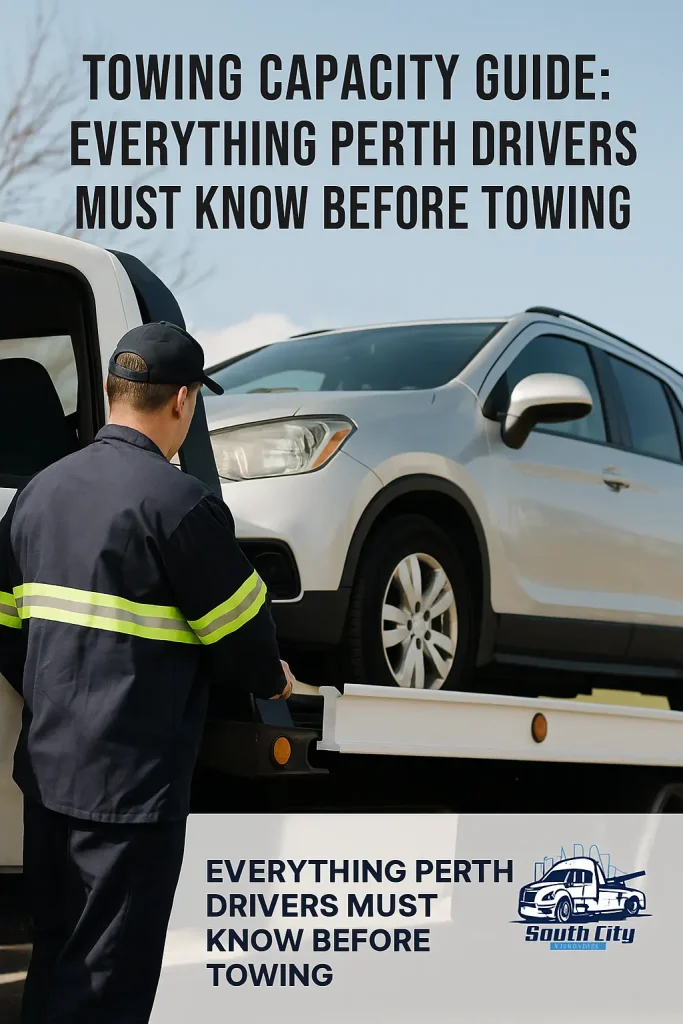
Towing Capacity Guide: Everything Perth Drivers Must Know Before Towing
Do you know if your car can safely tow a caravan, boat, or trailer?
Most Perth drivers lack the understanding about tow capacity of their vehicle and how much it can handle. And if you tow without knowing it, you can face costly repairs, safety risks, and even fines under Western Australian law.
At South City Towing, we’ve seen the consequences when people misjudge their tow capacity. So, let’s share the experience of our Perth towing team to save you serious regrets.
What is Towing Capacity?
When we talk about “towing capacity”, we mean the maximum weight a vehicle is rated to pull. That includes not just the trailer, but its load, plus any download on the tow-ball, and the base vehicle’s own load. Towing capacity is the figure given by the manufacturer that defines how much you can legally and safely tow.
Manufacturers derive this figure after testing engine power, braking systems, chassis strength and more. But in real-life your actual available capacity may be lower, depending on how much your vehicle is loaded, modifications, and other factors.
Towing Capacity Terms You Should Know
- Dry Weight: The weight of vehicle body without any fluid in it.
- Curb Weight: Total weight of your vehicle with all the required fluids in it (including a full tank of petrol).
- Gross Vehicle Mass (GVM): The maximum loaded weight of the vehicle (with the passengers, cargo, fuel etc).
- GAWR: Maximum amount of weight one axle can support. This value differs for front & rear axle.
- Gross Combination Mass (GCM): The maximum allowed mass of the vehicle plus the trailer together, when loaded.
- GCWR: Maximum weight your tow vehicle is rated to handle when fully loaded with a trailer and all cargo.
- Aggregate Trailer Mass (ATM): The loaded mass of the trailer (including contents) when un-hitched from the vehicle.
- Gross Towing Weight (GTW): It is the total weight of your trailer with its fully loaded cargo when it is hitched to the tow vehicle.
- Payload Capacity: Maximum amount of weight a tow vehicle can carry in its cabin and bed.
- Gross Vehicle Weight Rate (GVWR): Maximum amount of weight a vehicle can hold including the weight of vehicle itself.
When towing, you must make sure your system is within all of these limits. Check the vehicle’s manual, the towbar rating, the compliance plate, plus any local laws.
Braked vs Unbraked Towing Capacity
One of the most important distinctions: whether the trailer has its own brakes or not.
- Unbraked Towing Capacity: Maximum trailer weight when the trailer does not have its own brakes. In Australian vehicles, the unbraked towing limit is 750 kg maximum.
- Braked Towing Capacity: If the trailer has its own braking system, the allowable weight can be significantly higher. But it still must not exceed the figure given by the manufacturer for your vehicle.
Exceeding both these rating will increase the risk of brake failure, sway, and legal trouble. So, you must know and follow both these limits.
How Do I Find Out My Towing Capacity?
So, what amount of load are you actually allowed to tow? Let’s find out some simple measurement methods that can give you an estimate.
Manufacturer Ratings
Vehicle makers will list two figures (at least): the maximum braked tow capacity and the maximum unbraked capacity (for that variant). The actual usable capacity depends on how much load is already on vehicle (passengers, cargo, accessories) and what the trailer weighs.
How can I calculate my towing capacity?
Let’s tell you a simple formula to find out the towing capacity of your vehicle.
Available Tow Capacity = GCM – (actual loaded vehicle mass)
Where you need to account for:
- The weight of your fully laden vehicle (GVM)
- Passengers, cargo and fuel
- Tow-ball download (typically 5-10% of trailer mass)
- Any accessories fitted
So even if your vehicle is rated to tow, say, 3,000kg braked, you can only actually be able to tow less depending on your load.
Tow Capacity Calculators
There are online tools labelled “towing capacity calculator”. So, you can take the help from them. Just put your vehicle specs, trailer weights, registrations etc to estimate if you’re within safe & legal limits as defined by your local authorities.
Regulations and Legal Requirements in Western Australia
Since you’re in Perth and Western Australia, it’s essential to know the local rules.
Required Standards & Documentation
According to Transport WA, towing trailers, caravans and using tilt trays must comply with specific standards such as correct towbar rating, coupling, safety chains and load restraint.
The guide Safe Towing’ (IB-107B) sets out that if the vehicle’s towing capacity cannot be determined, the loaded mass of the trailer must not exceed the unladen mass of the towing vehicle. You also need to consider that where the trailer is braked.
If you’re hiring a towing service (or using one), note that from January 2025 WA introduced reforms to the towing industry. They set caps on towing charges in the Perth/Peel region (e.g., maximum $485 for first 50 km for light vehicles).
Speed & Driving Rules
In WA if you are towing a trailer or caravan:
- The maximum legal speed is the lesser of the posted limit or 100 km/h.
- People riding in a trailer or caravan being towed is prohibited.
- Loads must be secured properly, and failing to do so can cause infringement.
So, along with towing capacity, you should also check the trailer’s ATM and brake provisions and observe speed limits and load restraints while towing.
Risks of Exceeding Towing Capacity
Wondering what’s the need for such comprehensive regulations? Let’s share the consequences of towing beyond your vehicle’s capacity or ignoring the legal limits.
- Safety risks: Overloaded trailers can sway, reduce braking ability, and increase the chance of rollovers.
- Vehicle damage: Engine, transmission, brakes, suspension and towbar can all be stressed beyond their design.
- Legal and insurance issues: If you exceed limits, you can cancel your insurance, cause fines, or be held liable in an accident.
- Recovery costs: When things go wrong, you will need to hire professionals and bear the repair costs for your vehicle and additional fines.
In short, staying within capacity protects your vehicle, load, other road users & your wallet.
What Are Some of the Best Towing Vehicles Australia?
If you tow regularly, you’ll want a vehicle with strong towing capacity and proven reliability. Our experts suggest the following vehicles as reliable choices.
Vehicle Model | Approx Braked Tow Capacity* | Notes |
Toyota Land Cruiser 300 Series | ~3,500 kg | Heavy-duty, reliable for large caravans/boats |
Ford Ranger | ~3,500 kg | Great all-round dual-cab ute |
Isuzu D‑Max | ~3,500 kg | Strong value, good for work & towing |
Mitsubishi Pajero Sport | ~3,100 kg | Suits family plus towing needs |
Mazda BT‑50 | ~3,500 kg | Smooth ride and solid tow rating |
Remember that these figures are just approximates. Always check variant and manufacturer specs. These vehicles are regarded as among the “best tow vehicle in Australia” based on previous data, but individual case can vary.
Tips for Safe Towing
Let’s share some tips to maximise the capacity of your vehicle within safe and legal limits.
- Check tyre pressures on both vehicle and trailer before you move off.
- Verify that load is balanced: heavier items close to the trailer’s axle & low to ground.
- Use quality strap towing gear and safety chains: don’t rely on cheap or damaged parts.
- Make sure the towbar is rated correctly and the coupling fits the trailer.
- Drive slower than usual. Allow extra space for braking and be cautious of winds and uneven roads.
- Stop early to check lights, coupling, load for any shifts.
- Call professionals if you are finding any difficulties.
Towing with a Car vs Professional Towing: Expenses & Risks
Everyone thinks that towing with your own car is cheaper than hiring a towing service. But there are several hidden costs and risks involved.
Let’s compare them for you to make an informed choice.
Doing It Yourself
Pros: control, convenience, flexibility.
Cons: you must check weighing, loading, equipping and securing your trailer properly. If you get it wrong, you can face higher towing expenses, more wear and tear, and higher risk of breakdown or accident.
Using Professional Towing Services
When you call in a professional like South City Towing in Perth, you benefit from:
- A fully equipped fleet (tilt-trays, wheel-lifts) ready for different vehicle types, boats or caravans.
- Licensed operators who know how to load, secure and transport safely.
- Transparent pricing (with no hidden fees).
- Reduced risk of damage to your vehicle or trailer in transport.
In short, if you want affordable towing and have all the required knowledge and equipment, you can do it yourself. But if your setup is complex, like a boat, RV or low-clearance car or you need emergency towing, the extra cost of a professional tow is worth it.
Searching for Professional Towing Perth Service?
Call South City Towing: Perth’s Trusted Towing Experts
We serve you 24/7 across Perth and Western Australia, with transparent pricing and friendly team. Our fully licensed operators, specialised tools and a fleet ready for cars, boats, caravans, trucks or heavy vehicles, can help you tow safely and legally.
If you need emergency breakdown towing or scheduled transport,