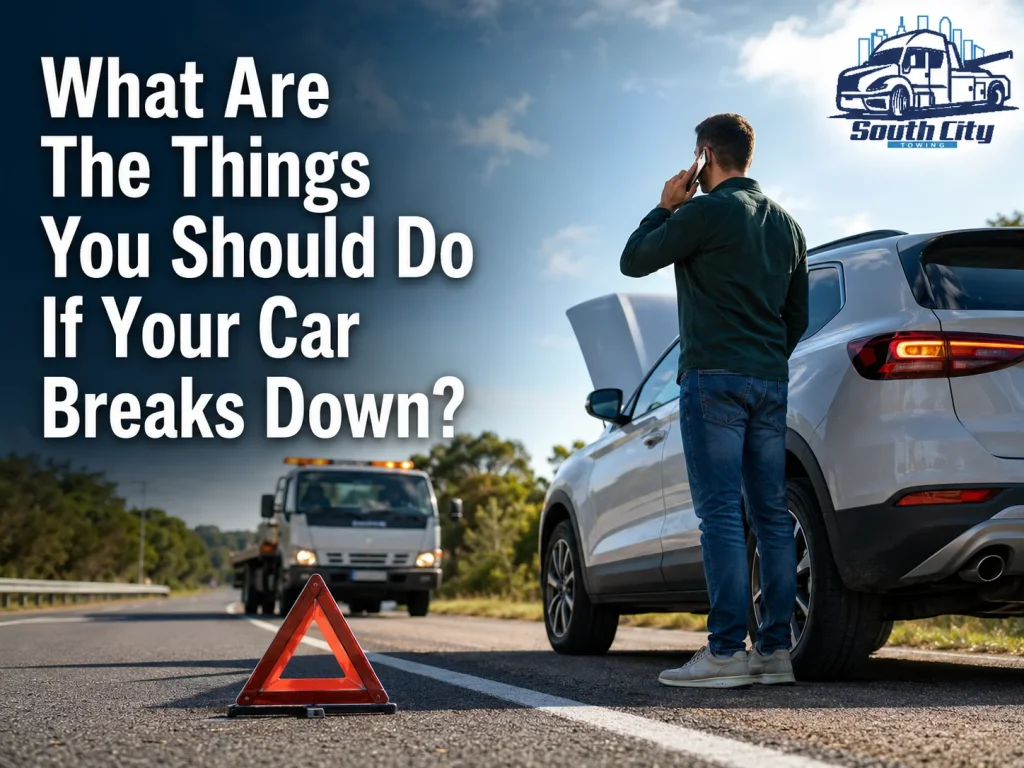
If your car breaks down, the first thing to do is to pull off the road safely, switch on your hazard lights, and call for help. As every second counts, especially on a busy Perth road or highway, make sure to stay calm.
Knowing what to do when your car breaks down can keep you, the oncoming traffic and the public safe and reduce damage to the vehicle.
So, this guide walks you through everything, from the moment your vehicle stops to getting back on the road safely.
Why Cars Break Down Is So Common in Perth?
Understanding why a car breaks down helps you stay prepared. In Australia, the most common causes are
- Flat or damaged tyres without warning.
- Dead or faulty batteries that often fail in Perth’s hot summers
- Overheating engine due to low coolant or a failing radiator.
- Running out of fuel on long country drives
- Electrical faults like starter motor failures.
- Transmission problems such as worn gearboxes and clutch failures.
Things to Do When Your Car Breaks Down: Step-by-Step Guide
Step 1: Stay Calm and Pull Over Safely
Don’t panic. Sudden braking or sharp steering movements can cause accidents. Signal early, reduce speed gradually, and move to the left shoulder in an emergency lane or any safe area off the road.
Once stopped, apply the handbrake firmly. If driving a manual, leave the car in first gear. If on automatic, set it to “P” (Park). This stops the car from rolling.
Step 2: Make Your Car Visible
Hazard lights are your first line of defence; turn them on the moment you sense trouble, even before you’ve fully stopped.
Besides that, other steps will also make your broken-down vehicle significantly safer for you and the public.
Distress Signal For A Broken Down Car | Why does it matter? |
Pop the bonnet | It is a universal sign that your car is broken down. |
Warning triangle | Place it at least 50 metres behind your car to warn other drivers to slow down. |
Reflective vest | Wear it to get out of the car, for safety on the highway, at dawn, dusk, and at night. |
Lights on in low visibility | Keep headlights on during rain on low beam to make your car visible. |
Step 3: Should You Stay in the Car or Get Out?
This is one of the most important questions, and the answer depends entirely on where you’ve broken down.
Stay In The Car If
- You’re on a highway, high-speed road, in a dark or unsafe location
- There’s nowhere safe to stand away from traffic
- It’s raining heavily, there’s lightning, or strong wind
Exit The Car If
- You’re on a quiet suburban or rural road
- There’s a clear area away from traffic
- You can exit from the passenger’s side
Step 4: Exit the Car Safely
If you need to get out, always exit from the side away from traffic. Check your mirrors and blind spots first. Move quickly to a safe area, behind a crash barrier or well onto the verge.
Do not stand between your car and oncoming traffic.
Step 5: Assess the Problem, But Only If It’s Safe
Check for obvious issues: a flat tyre, steam from the bonnet, or warning lights on the dash. If the fix is simple and safe (like a tyre change), handle it carefully.
If you’re not sure what’s wrong, don’t attempt repairs on a busy road. Wait for professional help.
Step 6: Call for Help
Once you’re safe and your hazard lights are on, call for assistance.
But who do you call?
So, if you are unable to find and fix the issue and your vehicle requires towing, call a professional towing company directly, like South City Towing (0492 013 846)
But when you call, you must know your exact location, the type of car you have, the issue that happened (if you know), and whether the car can steer.
If you’re unsure where you are, open Google Maps on your phone to find the exact location, even with a poor signal.
Step 7: While You Wait for the Tow Truck
You’ve called for help. Now, here’s how to stay safe and comfortable until it arrives.
- Keep your hazard lights on and stay off the road.
- Keep your phone charged and on so the driver can reach you
- Avoid accepting help from strangers unless you feel safe
- If the weather is hot, open windows slightly for airflow
- If it’s cold, stay warm inside the car, but don’t run the engine in a closed space
Items to Keep in Your Car to Minimise Breakdown Risk
Being prepared can make a car breakdown far less stressful. Keep these in your vehicle at all times.
- Warning triangle
- High-vi vest
- Torch
- Jumper cables
- Spare tyre
- First aid kit
- Phone charger
- Water bottle
- Basic tool kit
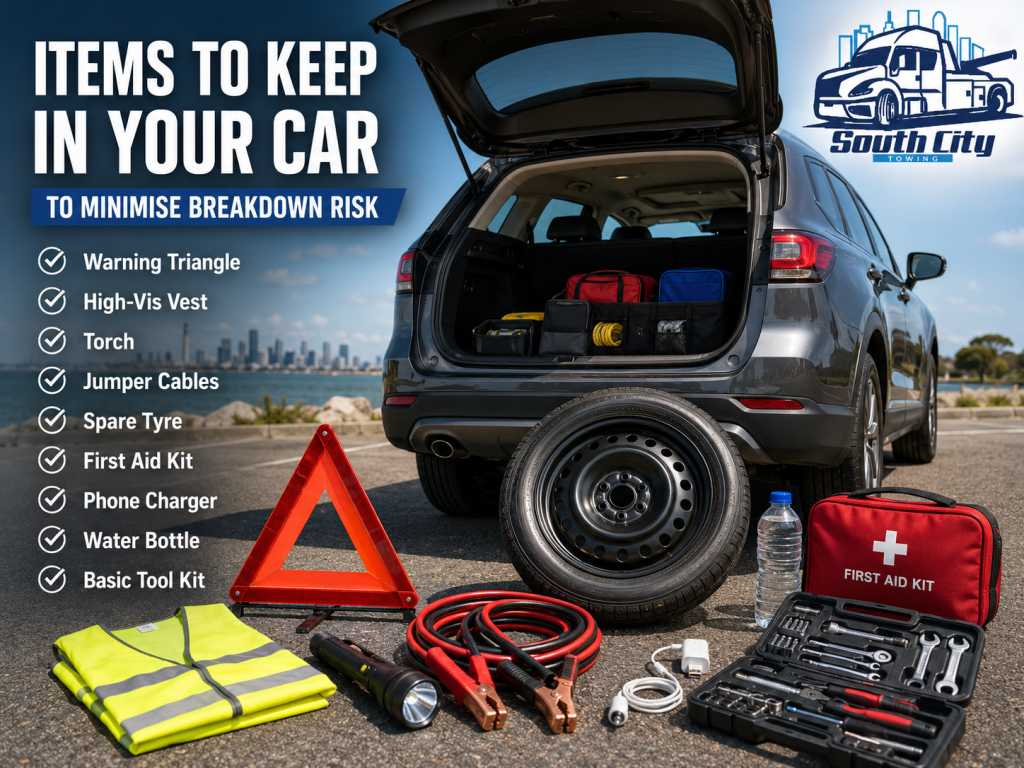
Check these items regularly to make sure they’re in good condition.
Here’s How to Stay Safe After a Breakdown
Remember, prevention is better than a recovery truck. Follow these tips to reduce the chance of being stuck in a car breakdown.
- Service your car regularly and stick to your vehicle’s maintenance schedule.
- Check tyre pressure monthly, as under-inflated tyres are more prone to blowouts.
- Perth’s heat is hard on car batteries, so test your battery before summer.
- Watch your temperature gauge and don’t ignore warning lights.
- Keep your fuel above a quarter tank.
- Inspect belts and hoses for cracks or wear.
- Pack an emergency kit before a long drive.
- Download a roadside emergency app to give your GPS location to help services.
A Quick Glance at Do’s and Don’ts During a Car Breakdown
DO | DON’T |
Switch on the hazard lights immediately | Slam on the brakes suddenly |
Pull as far off the road as possible | Stay parked in a live traffic lane |
Exit from the side away from traffic | Stand between your car and oncoming vehicles |
Place warning triangles behind your car | Try complex repairs on a busy road |
Call roadside assistance right away | Leave your car without securing the handbrake |
Stay visible in a hi-vis vest | Wander away from your vehicle at night |
Face traffic when standing outside | Accept rides from unknown strangers |
Keep passengers away from the road | Leave children or pets locked in a hot car |
Will Your Insurance Cover An Emergency Breakdown?
It depends on your policy. Standard comprehensive car insurance in Australia generally covers damage from accidents, but not mechanical breakdowns.
Roadside assistance cover is often a separate add-on or a standalone policy. It typically includes services like
- Towing to the nearest repairer
- Emergency fuel delivery
- Flat tyre changes
- Battery jump-starts or replacement
Check your current policy documents carefully. Some insurers include limited roadside cover automatically, while others charge extra. In Western Australia,
If your vehicle needs towing and your cover doesn’t include it, you’ll need a reliable towing service on call.
Get Fast Help Now With South City Towing: A Professional Roadside Assistance Service in Western Australia
South City Towing is Perth’s trusted 24/7 towing and roadside assistance provider. With over five years of experience serving Perth and Western Australia, the team is available day and night, no matter where you’ve broken down.
Our team in Western Australia
- Dispatches quickly with a GPS-tracked modern fleet
- Offering emergency roadside assistance
- Flat-battery assistance
- Flat-tyre assistance
Transparent pricing, licensed WA operators, and fast response times make us the go-to choice when you need help in a hurry.
Call Us Now: 0492 013 846, available 24/7 across Perth and WA.
FAQ
1- Where should you wait if your car has broken down?
If your car breaks down, wait in a safe spot away from traffic, behind a crash barrier if one is present, or well onto the road verge.
2- What are three things you should do if your car breaks down?
The three most important things are
- Pull off the road safely and switch on your hazard lights
- Exit the vehicle if needed and make yourself visible
- Call for roadside assistance immediately
3- What to do if your car breaks down and you have no signal?
If you have no phone signal, try moving to higher ground to get a signal. Use the free Emergency app; it can relay your GPS location when you dial 000. If there’s a roadside emergency phone nearby, use it.
4- What is the distress signal for a broken-down car?
The universally recognised distress signal is hazard lights on, pop the bonnet, place reflective warning triangles behind the vehicle, put on a hi-vis vest, and wave a brightly coloured item if needed.
5- Who should you call in an emergency car breakdown?
Call a local roadside assistance or towing service first. For breakdowns in Perth and WA, call South City Towing on 0492 013 846, available 24/7.