How Does Tilt Tray Towing Work? Step-by-Step
Watching your car get loaded onto a tow truck can feel stressful. You’re handing over something valuable, and it all seems to happen in a few quick minutes.
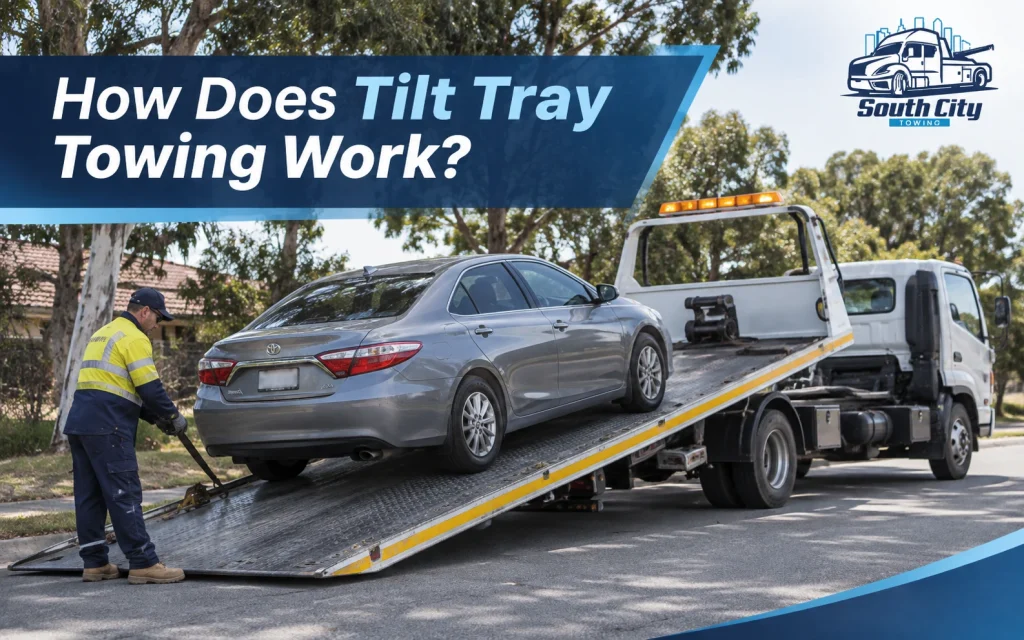
Here’s what’s really going on. A tilt tray uses hydraulics to slide its deck back and tilt it down to the ground, forming a ramp. Your car is then driven or winched up, the deck levels out, and the car is strapped down for the trip. Unloading is the same process in reverse. That’s the basic way tilt tray towing works.
The loading is only part of the job, though. Before anything moves, we check your car, our truck and the area around your car. In this blog, we’ll walk you through each stage so you know exactly what to expect, and why each step matters for your car.
The Parts That Lift and Carry Your Car
When a tilt tray arrives, these are the parts you’ll see at work:
|
Part |
What it does |
Why it matters for your car |
|
Power take-off (PTO) |
Draws power from the truck’s engine to run the hydraulics |
Lets the deck move smoothly and under control |
|
Hydraulic cylinders |
Slide the deck backwards and tilt it to the ground |
Create a long, low ramp instead of lifting one end of your car |
|
Winch and cable |
Pull your car up the deck |
Load your car even if it won’t start |
|
Controls or remote |
Operate the deck and winch |
Let the operator watch your car closely as it moves |
|
Tie-down points and wheel straps |
Anchor your car to the deck |
Keep your car steady for the whole trip |
|
Underlift or stabilising legs |
Fitted to some trucks only |
Allow a second vehicle to be towed, or add steadiness while loading |
What We Check Before Loading Your Car
Before anything moves, our operator works out three things: whether the truck suits your car, how your car will get onto the deck, and whether the area is safe to work in.
Your car
- Weight and size: in WA, tilt trays come in classes based on how much they can carry, so a large 4WD or van may need a bigger truck than a small hatch.
- Condition: does it start, roll and steer? Will the parking brake release? Are any wheels locked?
- Ground clearance: lowered suspension, body kits and low exhausts all change how your car is loaded.
- Drivetrain and power: many EVs need Tow or Transport Mode switched on before loading, and some need a scan tool if the 12V battery is flat.
Where your car is parked
- Space behind the truck, because the deck slides out past the rear
- Overhead clearance, because the front of the deck rises as it tilts
- Slope and ground, since soft sand or a steep driveway changes the plan
- Traffic and lighting nearby
That’s why we ask so many questions when you call. Your answers help us work out the right truck and equipment before we head out, so your car isn’t left waiting. On arrival, our operator also photographs any existing damage and explains how your car will be loaded.
How Does Tilt Tray Towing Work, Step by Step?
1. Positioning and Setting Up
We park in line with your car, as close and straight as the location allows. Hazard lights go on, and on a busy road, the area around the truck becomes a work zone. WA rules require tow trucks to carry a flashing amber light and a white work light for loading at night.
The PTO is then switched on to power the hydraulics. While you wait, keep well away from passing traffic and follow these tips to stay safe while waiting for help.
2. Sliding and Tilting the Deck
The deck slides backwards and tips down until its rear edge meets the ground. This creates a long, gentle ramp, which matters a lot if your car sits low.
3. Loading Your Car
If your car runs, it can usually be driven up slowly while the operator guides it. If it doesn’t, the winch pulls it up at a steady, controlled pace.
Before loading starts, we follow your manufacturer’s towing instructions. Depending on your car, that might mean selecting neutral, releasing the park brake or switching on Transport Mode.
4. Levelling the Deck
Once your car is in position, the hydraulics slide the deck forward and lower it flat onto the truck’s chassis. Your car now sits level, with no wheels touching the road.
5. Securing and Final Checks
Your car is secured at multiple tie-down points, often with wheel straps that hold the tyres rather than the bodywork, plus protective padding where needed. Under WA rules, a fully loaded vehicle must sit completely on the deck and be properly secured before the truck moves.
A final walk around checks the straps, clearance and lights. Loose straps and rushed loading are among the common towing mistakes that damage your vehicle, which is why this final check matters so much.
6. Transport and Unloading
On the road, your car rides level with nothing turning, which is one of the key benefits of tilt tray towing for AWDs, EVs and low cars. Our trucks are GPS-tracked, and we keep you updated on the way.
At the destination, the steps simply reverse: the deck slides back and tilts, the winch lets your car down gently, and it’s driven or rolled off. You then receive delivery documentation and a service completion report, which can help if you’re making an insurance claim.
What If Your Car Is Hard to Load?
Not every car rolls neatly up the ramp. These are the situations that need extra equipment or a different plan:
|
Your situation |
What may be needed |
|
Stuck in park, locked brakes or seized wheels |
Wheel skates or dollies placed under the locked wheels, so the car glides up instead of being dragged |
|
Flat or missing tyres |
Skates or dollies that act as temporary wheels during loading |
|
EV with a flat 12V battery |
Power restored, or a scan tool used, so Transport Mode can be switched on |
|
Parked in a low clearance car park |
A height check before arrival, and a careful approach with a spotter guiding the truck |
|
Very low or modified car |
Extension ramps at the end of the deck to soften the loading angle |
|
Heavy 4WD or van |
A tilt tray rated for the extra weight |
→ If any of these apply to your car, mention it when you call. It helps the right equipment get arranged before the truck arrives.
Imagine an AWD SUV with a flat 12V battery, parked on the lowest level of an apartment car park. It’s stuck in park and won’t power up for Transport Mode. In a case like this, the car would first need power restored or skates under its wheels, and a height check of the car park before the tilt tray heads in. A two-minute phone call about these details can save hours on the day.
WA Rules That Protect Your Car During a Tow
Tilt tray towing in WA isn’t a free-for-all. A few rules shape how every job is done, and they work in your favour:
- A tilt tray must hold a WA vehicle licence that allows it to operate as a tow truck.
- Tow trucks built after 7 November 2022 must meet AS 5400, the Australian Standard for tilt, slide and underlift tow trucks.
- Since November 2023, WA tow trucks have had to meet updated technical standards and pass an annual inspection.
You can read more on the WA Department of Transport and Major Infrastructure tow truck industry page.
What Helps Us Plan Your Recovery
The more we know before we arrive, the smoother your tow runs. Have these details handy when you call:
- Your car’s make, model and whether it’s AWD or electric
- Whether it starts, rolls and steers
- The exact location, plus any height limits, tight spaces or soft ground
For a full checklist before pickup day, these tilt tray preparation tips cover everything from belongings to keys.
Need Your Car Moved the Right Way? South City Towing Can Help
At South City Towing, every tilt tray job starts with a proper look at your car and its surroundings. With more than five years of towing across Perth and regional WA, and a GPS-tracked fleet of tilt trays and wheel lifts, we plan the load before the deck ever tilts.
When you’re ready to arrange tilt tray recovery in Perth, our team is available 24/7 with clear pricing and no hidden fees.
FAQs
How long does it take to load a car onto a tilt tray?
A car that drives can be loaded in a few minutes. Cars that won’t run, sit very low or are parked in tight spaces can take 30 minutes or more.
Is it bad if my car is dragged onto a tilt tray?
Winching a car that rolls freely is normal. Dragging locked wheels isn’t, as tyres can quickly flat-spot. Skates or dollies let locked wheels glide on safely.
Do tow trucks need a licence in WA?
Yes. A tilt tray must hold a WA vehicle licence that allows towing, and trucks used for crash towing face extra rules under the Towing Services Act 2024.
Can a tilt tray pull a car out of a ditch?
Sometimes, but not always. Many tilt tray winches carry only enough cable to load a car, so a car well off the road may need a recovery truck first.
Why are wheel straps used for electric cars?
Wheel straps hold the tyres instead of the underbody. That avoids pressure on battery casings, cooling lines and sensors that a wrong hook point could damage.
Is crash towing handled differently in WA?
Yes. Before towing from a crash scene, the driver must give you an Authority to Tow form to sign, showing the maximum towing cost and where your car is going.
Can I ride in the tilt tray with my car?
Many tilt trays have crew cabs with extra seats, but it depends on the truck and the company, so ask whether passengers can ride along when you book.WA