Benefits of Tilt Tray Towing: When Is It the Right Choice?
If your car is towed the wrong way, you could end up with a damaged gearbox, a scraped bumper or a drivetrain repair on top of the original problem.
A tilt tray helps you avoid that. Instead of pulling your car along with two wheels on the road, we load the whole vehicle onto the truck. Your tyres, transmission and bodywork stay protected from pickup to drop-off. That matters most if you drive an AWD, an EV or a lowered car, or if your vehicle can’t move after a crash.
In this blog, we’ll explain each benefit in detail, compare tilt trays with wheel lifts and tow dollies, and help you work out when your car genuinely needs one.
What Is a Tilt Tray Tow Truck?
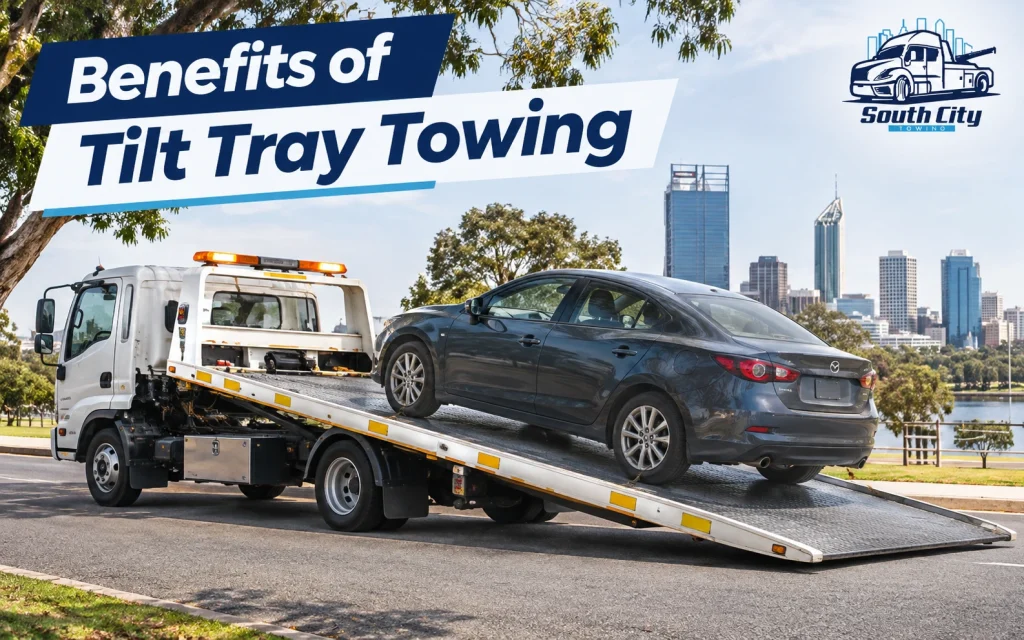
A tilt tray is a type of flatbed tow truck. Its deck slides back and tilts down to the ground like a ramp. We then drive or winch your vehicle up, level the deck and secure it with straps.
You’ll also hear it called a slide back or rollback. The WA Department of Transport and Major Infrastructure describes a tilt tray as a tow truck that carries the vehicle on its tray and uses a winch to pull it on board.
The other common option is a wheel lift, which raises one end of your car while the other two wheels roll along the road. Each of the different types of towing services has its place, and the benefits below show where a tilt tray stands out.
6 Key Benefits of Tilt Tray Towing
1. Reduces Wear and Tear on Your Drivetrain
When a car is towed with its wheels on the road, those wheels keep turning. In many vehicles, they also turn parts of the drivetrain, such as the gearbox, centre differential or transfer case.
That causes trouble for two common types of cars:
→ Automatics: the pump that moves transmission fluid around is driven by the engine. If the driven wheels are left on the road with the engine off, the gears can spin without proper lubrication, even in neutral.
→ AWDs and 4WDs: every wheel is linked through the drivetrain, so lifting only one end strains the parts connecting the front and rear.
A tilt tray keeps all four wheels still, so none of that strain happens. Remember, if you’re not sure whether your car is AWD, check the badge on the boot or your owner’s manual before calling for a tow.
2. Safer for AWD, 4WD and Electric Vehicles
Manufacturers spell out how their vehicles should be towed, and many point straight to a flatbed:
- Subaru names a flatbed truck as the best way to tow its AWD models.
- Mazda wants every wheel of its AWD models clear of the road during a tow.
- Tesla tells owners to transport its cars on a flatbed with the tyres off the road.
- Kia allows AWD models on a flatbed, or on a wheel lift only with dollies under the other wheels.
- Toyota permits a wheel lift for many models, but some AWD versions need a tow dolly.
These instructions are worth following. Damage from incorrect towing can mean an expensive repair, and it may not be covered by your warranty. A tilt tray fits within the guidance for almost every passenger car, which makes it the safe default when you’re unsure.
3. Ideal for Low Clearance and Sports Cars
Sports cars, lowered cars and vehicles with body kits often sit just centimetres off the ground. When a wheel lift raises one end, the other end drops even closer to the road, which can drag a rear bumper or exhaust over every bump.
A tilt tray avoids that problem. The deck tilts right down to the ground for a gentler approach angle, and your car sits level once it’s on board. That lowers the risk of scraping bumpers, front splitters, undertrays and exhausts.
If your car already scrapes on speed humps or steep driveways, take that as a clear sign to ask for a tilt tray.
4. Handles Damaged Cars That Won’t Roll or Steer
A wheel lift relies on the wheels left on the road. Once those wheels can’t turn, that method stops working.
A tilt tray uses a winch to pull the vehicle onto the deck, so it can safely move cars with:
- Bent suspension or a broken axle
- Locked steering
- Flat, damaged or missing tyres
- Years of sitting untouched in a shed or backyard
That’s why tilt trays are the first choice for accident towing, where cars are often too damaged to roll safely.
5. Versatile Enough for Almost Any Vehicle
So, what types of vehicles can a tilt tray tow? More than most people think.
A wheel lift needs a solid axle and healthy tyres to grab. A tilt tray simply needs the vehicle to fit on the deck, stay within the truck’s weight limit and have strong points to strap down. That flexibility means one truck can carry hatchbacks, sedans, 4WDs, utes, small vans, EVs, classic cars and even motorcycles.
This is a big reason tilt trays handle most specialised towing. You don’t need to know the right equipment in advance, because a tilt tray covers the widest range of vehicles and situations.
6. Better for Long Distance Towing
On a wheel lift, every kilometre adds wear to the tyres and drivetrain left on the road. Across a few suburbs, that rarely matters. On a trip from Perth to Bunbury, Albany or Kalgoorlie, it adds up quickly.
On a tilt tray, your car arrives with no extra tyre wear and far less exposure to road grit and stone chips. If you’re planning a regional move, it helps to understand what affects long-distance car towing costs so you can budget properly.
Tilt Tray vs Regular Tow Truck: How Do Other Methods Compare?
A tilt tray gives your car the most protection, but it isn’t the only option. Here’s how it stacks up against the other towing methods you’ll come across in Australia.
|
Method |
How it works |
Best suited to |
Watch out for |
|
Tilt tray |
Whole vehicle carried on a flat deck |
AWDs, EVs, low cars, crash damage, long trips |
Needs room to tilt and enough height clearance |
|
Wheel lift |
Raises one axle while the other wheels roll |
Healthy 2WD cars on short trips |
Can strain AWD drivetrains and scrape low cars |
|
Wheel lift with dollies |
Small wheeled frames lift the trailing wheels too |
Getting an AWD out of tight spots |
Slower to set up and best kept to short distances |
|
Hook and chain (sling) |
Chains wrap around the axle or frame |
Old wrecks and scrap cars |
Toyota and Mazda manuals warn against it for their cars |
|
Tow rope or tow bar |
Another car pulls yours |
Very short emergency moves |
Needs a driver behind the wheel and working brakes |
A wheel lift is usually quicker to hook up and often cheaper, so it still makes sense for a healthy front wheel drive hatch going a few kilometres. Our GPS-tracked fleet includes both tilt trays and wheel lifts, so we match the truck to your car rather than forcing one method onto every job. Our tilt tray towing in Perth covers the metro area and regional WA.
When a Tilt Tray Needs Extra Planning
A tilt tray needs space to work. The deck slides back, and its front end rises as it tilts, so the truck needs space and firm ground underneath. Let us know early if any of these apply:
- Underground or multi-level car parks: the raised deck needs headroom, so we check the height limit before sending a truck.
- Tight driveways or laneways with little room behind the vehicle.
- Soft sand, gravel or wet grass that could bog a heavy truck.
- Heavy 4WDs or vans: in WA, the smallest class of tilt tray is limited to towed vehicles of 2,030 kg, so bigger vehicles need a larger truck.
- Locked wheels that may need extra equipment before winching.
None of these will stop the job. They simply help our team plan the right approach before arriving. To see what happens on the day, read about how tilt tray towing actually works.
Is a Tilt Tray Right for Your Vehicle?
Ask yourself these four questions:
- Is it AWD, 4WD or electric?
- Is it lowered, modified or valuable?
- Is it damaged or unable to roll?
- Is it travelling more than a short distance?
If you answered yes to any of them, a tilt tray is the safer choice. Once that’s settled, a few simple steps will prepare your car for tilt tray collection and help pickup run smoothly.
Not Sure Which Truck You Need? Talk to South City Towing
At South City Towing, we’ve spent more than five years moving cars, 4WDs, EVs and motorbikes across Perth and regional WA. When you get in touch, we’ll ask about your vehicle and where it’s parked, then send the truck that suits it best.
Our team is available 24/7, and our pricing is transparent with no hidden fees, so you’ll know the cost before we arrive.
FAQs
Can I ask the towing company to send a tilt tray?
Yes. Share your car’s make, model and drivetrain when you call, then ask for a tilt tray. A good operator will confirm the right truck before dispatch.
Is a tilt tray more expensive than a regular tow truck?
It can be, because tilt trays are larger and take longer to load. Distance, vehicle condition, access and timing also shape the price, so always ask for an upfront quote.
What is the difference between a tilt tray and a tilt and slide?
Both are flatbed tow trucks. A tilt and slide deck also moves backwards as it tilts, giving a lower loading angle that suits very low cars.
Can a tilt tray carry one car and tow another?
Some can. Certain tilt trays have an underlift at the back, letting them carry one vehicle and tow a second within strict weight limits.
What if my electric park brake won’t release?
Tell the operator before they arrive. A tilt tray is usually the best option, and some makers, including Kia, recommend a flatbed when the park brake won’t release.
Is a tilt tray the same as a car carrier?
No. A car carrier moves several drivable cars on fixed decks, while a tilt tray carries one vehicle and can winch on cars that don’t run.
Does roadside assistance cover tilt tray towing?
It depends on your membership or insurer. Many cover towing to a nearby repairer, but distance limits and vehicle rules vary, so check your policy first.